|
|
|
|
|
Model Railroad Crossing Signal and Crossing Gate Control System
|
Where do most folks see trains in the real world? At a grade crossing. Visitors to your model railroad layout will mentally connect your crossing signals to the real world. The more realistic your model train grade crossings, the stronger the connection.
Give your visitors a visual treat. A realistic operating grade crossing signal system will definitely boost the 'cool' factor of your railroad layout.
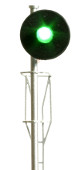
Looking for trackside block signal control circuits?
• For the TS2-TS3-TS5 three-color system, click here.
• For simple green/red signaling, click here.
|
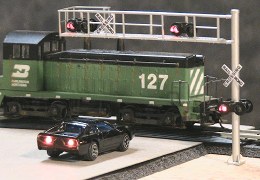
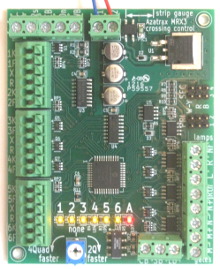
MRX3 circuit includes a connection for non-flashing lamps, like these automobile brake lights
|
Grade Crossing Signal Flashers
- Control circuits and flasher circuits for road crossing warning lights with or without crossing gates.
- Sophisticated microprocessor controller.
- Manual control capability.
- Easy to daisy-chain controllers for multiple parallel tracks.
- Compatible with most block occupancy detectors.
Now with 4-quadrant crossing gate control
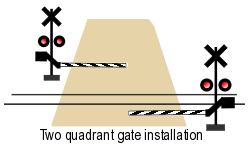
What are four-quadrant crossing gates? Typical North American railroad crossing gates on two-way streets block traffic
on half of the road. The gates cover the lanes of approaching traffic, but not the lanes leading away from the tracks. Foolish
drivers sometimes cross the highway median, drive around the gate then get hit by a train.
To reduce collisions at grade crossings, railroads are installing four quadrant gate systems on high speed rail corridors,
commuter lines, light rail systems and in areas with high concentrations of foolish drivers.
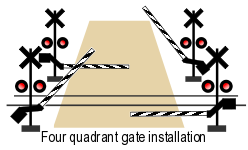
Four quadrant gates block all lanes of traffic on both sides of the tracks. Gate operation is sequenced. The 'entrance' gates
close first, blocking approaching cars. Then the 'exit' gates close on the opposite side of the tracks. The delayed closing of
the exit gates prevents vehicles from being trapped on the tracks.
This video shows a BNSF railroad
four quadrant grade crossing in action, [click here].
MRX3 crossing signal controller with or without pre-wired infrared sensor sets
Select the number of IR sensors to include with the MRX3.
|
- Four IR sensor sets, 2 ft (60cm) and 6 ft (180cm) wire length.
4 sensor sets for one track, or
2 sensor sets per track, 2 tracks.
- Five IR sensor sets, two with 2 ft (60cm) and three with 6 ft (180cm) wire length.
Use at a single track crossing with a track switch near the crossing.
See the crossing system configurations page for details.
- Six IR sensor sets, two with 2 ft (60cm) and four with 6 ft (180cm) wire length.
6 sensor sets for one track, or
use with two MRD1 single detectors (sold separately below) to protect two tracks with 4 sensors per track.
- No IR sensors included.
For use with block occupancy detectors or with your own infrared sensors.
You can splice up to 26 feet (8 meters) of additional wire to the sensor leads if a longer reach is needed.
|
|
MRD1-NV single IR train detector.
Add two MRD1-NV detectors with the 6-sensor MRX3 (above) to protect two tracks at one crossing with 4 sensors per track.
Price shown for each MRD1-NV.
|
|
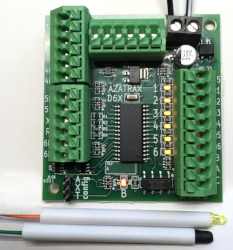
D6X HexDetex with four or six pre-wired infrared sensor sets
Select the number of IR sensors and their wire length.
|
- Four sensor sets for crossing signal control where only four sensors are needed.
Two sensor sets with 2-ft (60cm) wire length.
Two sensor sets with 6-ft (180cm) wire length.
- Six sensor sets, all with 2-ft (60cm) wire length.
Use when all detection zones are close together.
- Six sensor sets, two with 2-ft (60cm) wire length
and four with 6-ft (180cm) wire length.
Use when detection zones are widely separated, or
for crossing signal control where six sensors per track are needed.
- No IR sensors included.
For users who will use their own IR sensors.
You can splice up to 26 feet (8 meters) of additional wire to the sensor leads if a longer reach is needed.
|
|
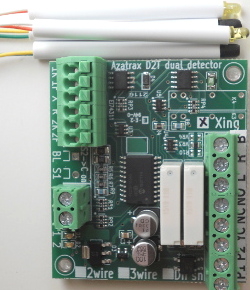
• Installation guide [pdf]
• IR sensor installation tips
• Resistor connection diagram for LED signals
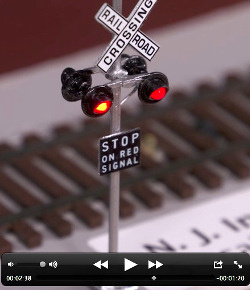
Steve Doyle and Doug Hodgdon of Model Railroad Academy discuss the D2T-Xing basic crossing signal controller.
Click to watch the video.
|
D2T-Xing
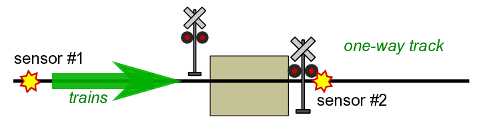
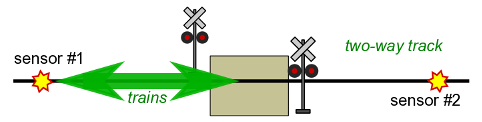
Basic crossing signal flasher circuit with two IR sensors for a single track road crossing
- Flashes incandescent bulbs or common anode (+) LEDs.
- Soft on/off lamp fading.
- LED signals must be wired with positive side as 'common.'
- NJI, Tomar and Walthers crossing signals are wired this way, as are most other commercially made crossing signals.
- If your LED signals do not already have resistors installed, use the resistors included with the D2T-Xing circuit.
- Click here for resistor diagram for LED signals.
- Normally open and normally closed relay contacts for controlling other accessories such as sound effect modules, lights, slot car tracks, etc.
- Can be used with signals that have built-in flasher circuits such as MTH RailKing™
crossing signals and Lionel 6-14098 crossing gates.
- Circuit board dimensions: 2.5 x 2.35 inches (64 x 60 mm).
- Power required: 9 to 16 volts AC or DC.
Signals sold separately on these pages:
|
D2T-Xing with two pre-wired infrared sensor sets
Includes one IR sensor set with 2-ft (60cm) wire leads and one IR sensor set with 6-ft (180cm) leads.
|
|
© copyright 2009-2026 Azatrax LLC, Longmont, Colorado
|
|