|
|
|
|
|
Using current sensing block occupancy detectors with the Azatrax MRX3 crossing control circuit.
|
The MRX3 crossing signal controller senses train movement near a model railroad grade crossing, and uses that information to operate crossing signals and crossing gates.
Although the MRX3 has built-in detector circuits to use infrared (IR) train sensors, current sensing block occupancy detectors may be used with the MRX3 instead of the IR sensors.
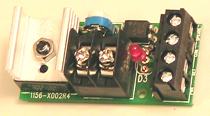 Block detectors sense the presence of a train in a track block. A block is a length of track that has one rail electrically isolated from the rest of the layout. Power to that rail is routed through a block occupancy detector. When the block detector senses current flowing into the track block, it switches its output to indicate that a train is present.
The MRX3 controller will work with any block detectors that switch their output to 'ground' (the negative side of the DC power supply) when the block is occupied. This is the case for nearly all block detector circuits.
The exception is Digitrax®. Their detectors typically switch to the positive side of the power supply. This does not work with the MRX3. Contact us for help using Digitrax® detectors.
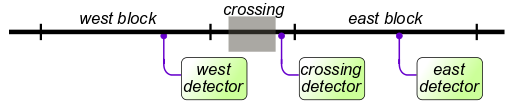
The drawing above shows where to place the three block detectors. One is for the western block, one for the crossing ('island') block, and the third is for the eastern block. Connect each detector to the track according to the detector instructions.
|
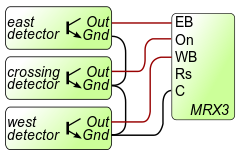
Connect the three block detectors to the MRX3 signal controller as shown at left. Be sure to connect all 'ground' or 'common' points on each detector to terminal C on the MRX3.
Do not connect any IR sensors to the MRX3 when using the MRX3 with block detector circuits.
|
Send questions or comments via our contact page.
© copyright 2009-2020 Azatrax LLC, Longmont, Colorado
|
|

