|
|
|
|
|
Run Two Trains on One Track
|
Two trains run on a single-track loop, infrared sensors automatically keep them separated.
If you have an exhibit or display layout, why settle for one continuously running train when you can have two trains? This page shows how to run two model trains on a single loop of track in the same direction.
To see how to run two trains in opposite directions on a single track, see the next page.
This simple method uses one infrared train detector to control power to an electrically isolated section of track. It works for trains with a single engine. The isolated section should be slightly longer than the longest locomotive used on the layout, plus stopping distance. For 3-rail layouts, isolate the center rail.
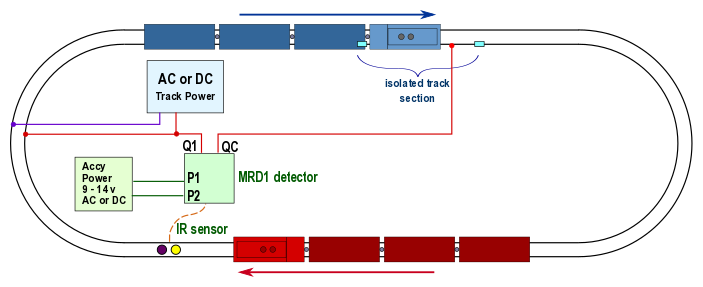
In this diagram, the red and blue trains travel clockwise around the loop.
The blue train is stopped, its locomotive is on the isolated section of track. The red train is moving, and is approaching the train detector.
When the red train activates the detector, the detector's on-board relay turns on and switches power to the isolated section via
terminals Q1 & QC.
As long as the detector is sensing the red train, the isolated track section will have power, so the blue train can move far enough to exit the isolated section.
The two trains continue moving clockwise. When the red train reaches the isolated track section, it will stop until the blue train reaches the detector.
With 3-rail track, the same operation can be done using a relay as the train detector:
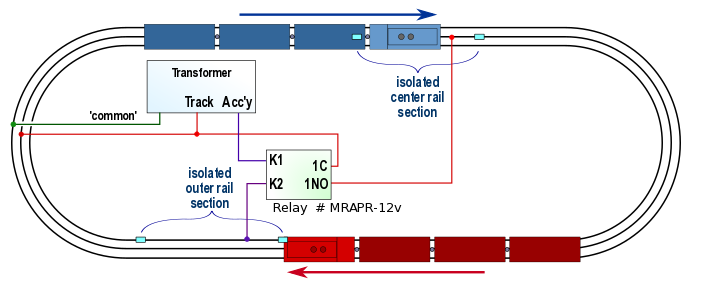
If the relay "chatters" then the rails and wheels need to be cleaned.
The MRAPR-12v relay can be ordered from the relays page.
But -- what if the blue train fails to start after the detector turns on?
What if one train stalls somewhere? The other train will come around and crash into the rear of the stopped train!
Want to automatically run two trains in opposite directions on a single track loop? Click here for the next page.
|
© copyright 2009-2020 Azatrax LLC, Longmont, Colorado
|
|

