|
|
|
|
|
Triple Head Signal Adapter
This adapter enables the use of a 3-head trackside signal when used with an
Azatrax TS3 or TS5 signal controller
|
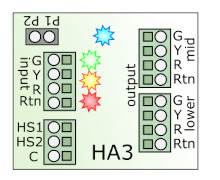
• Download the HA3 installation guide [pdf]
|
Triple head trackside signals are often seen at the entrance to a control point or interlocking plant
where there are at least three possible routings with three different speed limits,
• track speed (normal speed, the posted limit)
• medium speed
• slow speed (or 'restricting').
|
|
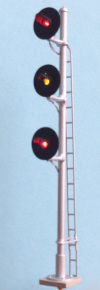
triple head signal
|
An Azatrax TS3 or TS5 signal controller by itself can operate a 2-head signal to indicate whether a train
may proceed at track speed for the straight-through route, or at a lower speed for a diverging route.
The actual speeds in mph (or kph) are specified in the railroad's timetable.
HA3 works only with triple head LED signals that are wired in "common anode"
(common positive) configuration.
|
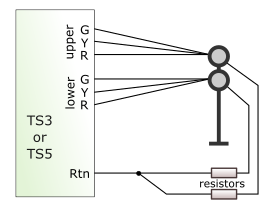
TS3 or TS5 connected directly to a dual head signal.
|
Suppose there is a third possible route that requires an even slower speed. A third head is
added to the signal.
The lower signal outputs of the TS3 or TS5 signal controller are wired into the HA3 adapter.
Normally the HA3 passes the signal color from the controller to the middle head of the signal,
and it sets the bottom signal head to red.
When the slowest route is selected, the HA3 sets the middle head to red and passes the signal color
from the controller to the bottom head.
|
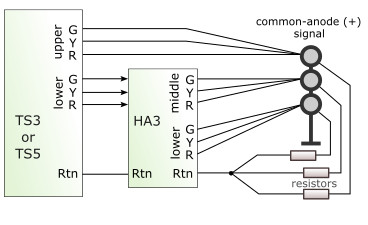
HA3 sends the diverging signal color to either the middle or
bottom head depending on the selected route.
|

clear
normal speed
|
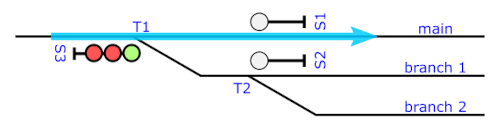
A TS3 signal controller and an HA3 3-head adapter operate a triple head signal at this control point.
Each turnout will need an electrical contact to indicate the position of its point rails.
Here the turnouts are lined for the main route.
|

clear
medium speed
|
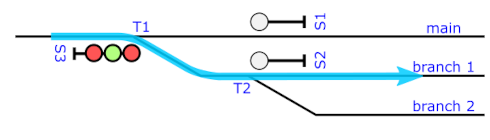
Here the turnouts are lined for the medium speed route.
Turnout T1 is in the 'reverse' position, T2 is in the 'normal' position.
|

clear
slow speed
|
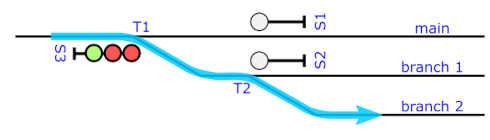
Here the turnouts are lined for the slow speed route.
Turnouts T1 and T2 are both in the 'reverse' position.
|
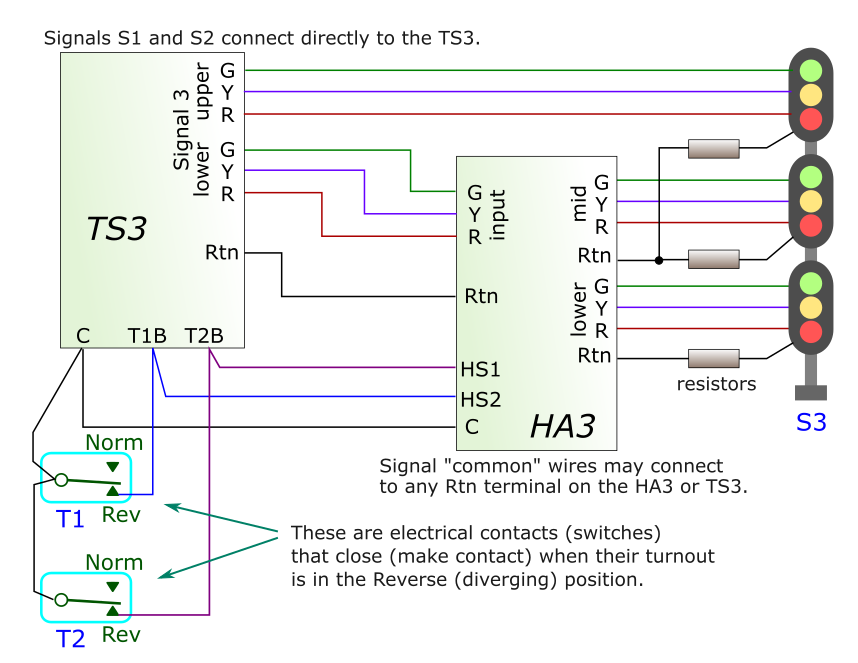
This is how the TS3 signal controller and HA3 are connected together to control the 3-head signal in the example above.
Turnouts T1 and T2 each need an electrical contact that closes (makes contact) when
the turnout is in the 'reverse' position.
Some switch machines such as the Cicuitron Tortoise motor
have suitable contacts built in. For powered switch machines that do not have built-in contacts a
latching relay may be used.
For hand operated turnouts, Caboose Industries makes ground throws with an electrical contact.
HA3 works only with triple head LED signals that are wired in "common anode"
(common positive) configuration.
|
|
Click here for the HA3 installation guide.
© copyright 2009-2026 Azatrax LLC, Longmont, Colorado
|
|

